
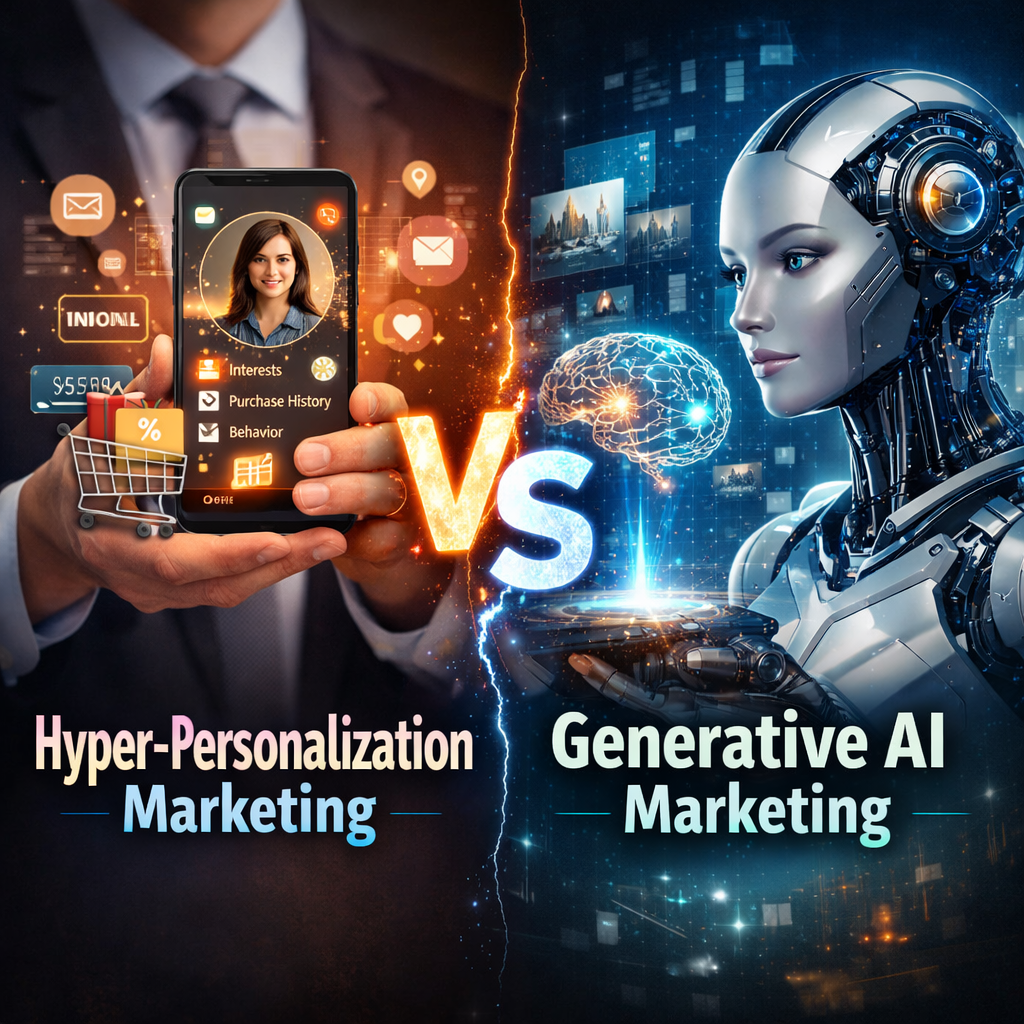
Marketing doesn’t suffer because of a lack of tools. Its lack of relevancy causes it to flounder.
You may send emails. You may run advertising. This may make you post every day. But if your message doesn’t seem created for the individual reading it, it is ignored. Because of this, hyper-personalization marketing has gained importance. At the same time, Generative AI Marketing is booming, offering speedier content and unlimited creative creation.
Here’s where people have confusion.
They believe that these two are identical. They’re not.
Understanding the difference and how they function together is the key to designing tailored marketing solutions that truly increase engagement and conversions.
What Is Hyper-Personalization Marketing?
Hyper-Personalization is a marketing approach that is all about the person, not the group of people who are likely to buy something.
Real-time data, tracking of behavior, and AI-driven insights are used to make marketing more relevant based on
- What the person looked at
- What they clicked on
- When they start to
- Where are they in the process
- They’re most likely to need it for the next time
This is a lot more than just putting your first name in an email. What it means:
- Giving different people different deals
- Messages sent at the right time
- Changing information based on how people act
- Changing the customer trip on the fly
Instead of asking, “What do people like?”
“What does this person need right now?” you ask.
That’s why marketing with hyper-personalization works better:
- Rates of click-through
- Rates of conversion
- How the customer felt
- Keeping them
It doesn’t feel pushy; it feels useful.
What Is Generative AI Marketing?
Generative AI Marketing is the next thing we’ll look at.
This is how AI is used to make business material, such as
- Blog posts
- Copy of the email
- Different ads
- Descriptions of the goods
- Social captions
- Answers to chat
Speed and size are its strong points. It’s possible to make more material in less time.
But here’s what most people don’t see:
This is not an information engine; it is a content engine.
It can write 50 different kinds of emails, but it doesn’t know:
- Which version should we send to which user?
- When to send it
- Which deal works best for you?
- The user’s place in the journey
This is where marketing with a lot of tailoring comes in.
Hyper-Personalization vs Generative AI Marketing
Look at this in this way:
Hyper-Personalization Marketing
- Putting the person first
- Data and actions are used
- Picks out who, when, and why
- Makes things relevant
- Makes the experience better
Generative AI Marketing
- focuses on what it says
- AI models are used to make text
- Makes it possible to say
- Drives speed
- Brings out more
Being smarter about marketing is one.
The other one speeds up selling.
Both don’t work well when used by itself.
- When there is no material, personalization is slow and limited.
- AI material that isn’t customized is boring and general.
Customized marketing solutions really come to life when people work together.
Why Your Current Marketing Feels “Off”
If your marketing seems to be working but isn’t truly effective, you likely encounter one of these issues:
Your personalization lacks depth.
Segments like “new users” and “returning customers” exist, but individuals behave very differently within those groups.
You utilize AI tools, yet the results fail to improve.
AI assists you in producing content, but it fails to enhance relevance without customer data.
Your customer journeys are overly complex.
Manual targeting struggles to match modern buyer behavior.
You possess data, yet you take no action.
You gather insights but fail to convert them into automated decisions.
Hyper-personalization marketing directly addresses the gap.
How To Combine Both For Real Results
Here’s the practical element – the bit most marketers are really searching for.
Step 1: Connect data before content
Prior to creating more emails or advertisements, connect:
- CRM data
- Website behavior
- Purchase history
- Engagement patterns
This provides context for AI. Without this, material remains generic.
Step 2: Use AI to assist in decision-making rather than merely writing
Make predictions using AI:
- Best time to send
- Perfect channel
- Best product suggestion
- Likely intent
This converts marketing from reactive to proactive.
Step 3: For dynamic variations, use generative AI
AI is now becoming more powerful. It may produce several versions of information depending on:
- User interests
- Funnel stage
- Behavior patterns
- Past purchases
Instead of one email campaign, you execute hundreds of micro-experiences automatically.
Step 4: Create Tailored Marketing Strategies
A universal configuration does not exist. Your company has:
- A unique consumer journey
- Different purchase cycles
- Industry-specific requirements
Customized marketing solutions combine:
- Personalization engines
- Data platforms
- AI tools
- Automation workflows
This is where technology and strategy come together.
What This Means For You
“More content” is not necessary.
You need more intelligent delivery.
Hyper-personalization and generative AI marketing are not mutually exclusive. The true benefit comes from employing generative AI to scale what hyper-personalization chooses.
That’s how marketing begins to seem human again even at scale.
Customers notice when messages:
- Arrive at the proper moment
- Reflect their needs
- Solve genuine issues
It’s not a coincidence. That’s intelligent personalization enabled by AI.
The Future of Marketing
From campaigns to interactions, marketing is changing.
The brain is what hyper-personalization marketing gives. Generative AI marketing gives a voice. Customized marketing solutions bring the two together.
That’s when marketing stops getting in the way and begins helping. And that’s precisely what buyers now want.
Reasons Why This Method Feels Better
Ironically, AI-powered customization seems more human than marketing done by hand. Why?
Because it reacts.
- Ideally, you say something when someone displays interest.
- Then you help others when they are unsure.
- You give them a prize when they come back.
Being responsive develops trust. And trust makes money.
Final Thoughts
Generative AI Marketing and Hyper-Personalization Marketing are not the same thing. In the same plan, they have distinct jobs.
One knows the consumer. The other person gets the point across. When you combine both with Customized Marketing Solutions, your marketing stops seeming like noise and begins sounding like advice.
And that’s what people demand from businesses nowadays. Importance. Timing. Smartness.
If your marketing is almost functioning but not quite, this integration is perhaps what you need. You know what to do now.
FAQs
- Is hyper-personalization possible, assisted by generative AI?
Hyper-personalization may be assisted with the help of generative AI when it is paired with real-time behavioral information. It produces a number of copies of dynamic content for each consumer based on the demands, stage, and preferences of the consumer.
- What are the issues in Customized Marketing Solutions?
In some cases, custom marketing solutions become problematic in aspects such as data unification, privacy requirements, tool cooperation, and brand message consistency across the automated systems.
- Can hyper-personalization marketing be the correct choice for small businesses?
Yes, even being a small business, it is possible to use simple tools to track data and automation to make hyper-personalization functional to a small-scale business. Even minor things in behavior can create a significant impact on engagement and conversions.
- Does Generative AI Marketing replace human marketers?
No way! The generative AI assists marketers by accelerating the content creation and experimentation with new variations. Individuals have yet to reason, be creative, and make decisions to achieve large outcomes.
- What do I have to do to begin creating Customized Marketing Solutions?
Begin by relating your customer information storage locations and discovering what makes the customer do what. Then, for what real people wish, include automation and AI-generated content.